No products in the cart.: ₹0.00

By Suraj Kumar
0 Comments
Your garam masala recipe matters far less than the minute you tip it into the pan.
Garam masala belongs at the end of cooking, not the start
“Garam” means warmth, and not chili-hotness, and the name gives the purpose of the blend – to finish a dish. The oils from the cardamom, cloves, and cinnamon dissipate quite quickly, thus a blend which is allowed to simmer for forty minutes will only leave its fragrant smell in the steam and not on the plate. If you add it in the final thirty seconds, the aroma will end up in the bowl.
Try this tonight. Prepare one pot of dal and divide it into two separate pans. Add half a teaspoon of garam masala to the first pan once it starts to simmer, while adding the same amount of it to the second pan after switching off the stove, and let it stand covered for two minutes. Taste the dishes. The second pan will smell like a spice shop. The first one will smell like dal.
Most cooks do not notice this because there are actually two distinct procedures that share the same name. Adding the whole spices to the hot ghee right in the beginning creates the base layer, the tadka or bagar. Adding ground garam masala at the end provides the finishing touch. Rajma, chana masala and even a decent biryani all use both, and a cook that confuses one for the other will get only half of the dish done.
This makes it necessary to rethink your methodology in writing down the procedure. Mentioning “1 tsp garam masala” on the same line as onions and tomatoes encourages the reader to add it in the same place, and thus he ends up with an incomplete dish despite following the proper ratio. Instead provide the garam masala with its own step such as: “Switch off the flame, add ½ tsp of garam masala, cover for two minutes.”
No authentic garam masala recipe exists, so stop looking for one
Each region has its own unique mix, and most houses have their own special twist to it. Bengali gorom moshla has only three ingredients: green cardamom, cinnamon, and cloves. In the case of Punjabi spices, there is black pepper, cumin, coriander seeds, and possibly even a bay leaf for a more grounded and earthy mix. In the case of Mughlai-inspired mixes, there is mace, nutmeg, and shahi jeera to give it a more perfumed flavor. Different store-bought brands like MDH, Everest, and Catch each use a unique mix of spices, thus changing how butter chicken tastes.
This makes “authentic garam masala recipe” a marketing slogan instead of a fact. Such posts, by insisting on an authentic recipe, condition readers to look at spices like a chemist would look, with the slightest variance equated with an error. The mixing is an art. A person believing in an authentic formula will start measuring rather than tasting, and measurement will not save anything in a boring pot of food.
Publish your mix as your own, and describe what each group of spices does. Sweet-warm spices (cinnamon, cardamom, cloves) provide flavor. Black pepper provides spiciness. Cumin and coriander provide body. Tell the readers what lever to use: add more cardamom if the recipe calls for a soft paneer, or more pepper if the dish calls for a spicy mutton curry. The reader knowing about the levers will fix any mix. The reader believing in an authentic ratio will just repeat it.
If you ask three aunties for their recipe for garam masala, you will get three different recipes, and all of them will be said with utmost confidence. But all of them are correct because what matters is whether the final dish tastes good or not.
The health benefits are real but small, and the dose sets the limit
The serving of the dish provides around half a teaspoon of the mixture, approximately one gram of spices. This amount is the key factor in everything you may mention concerning the health benefits.
The spices certainly have some qualities. Piperine in black pepper helps increase the assimilation of curcumin contained in turmeric, making the combination of the two ingredients slightly more effective. Cloves are high in eugenol that gives this ingredient its distinct sharpness and medicinal aroma. Ayurveda considers cardamom, cinnamon and cloves as the “warming spices” that have been used for thousands of years to facilitate digestion; that’s where the term “garam” comes from. It’s quite correct to mention these facts as long as you refer to tradition.
Such a statement would be wrong, as a single gram of spices will help you nothing, while a recipe website claiming such a thing is betting its reputation on something it cannot prove. Say something that you can prove. The spices have a rich history as a digestive aid, and the amount of spices in a regular portion is small.
The best proof that a recipe gives is something that you can prove in your kitchen: aroma decreases the need for salt. Most of the taste you feel depends on smell, so the food that smells as if it should smell tastes complete with fewer portions of both salt and oil. Cook a simple moong dal with a regular amount of salt, distribute it into two bowls, but add the garam masala to one of them. Then try both dishes and salt them. The second portion requires less. That is the health effect worth writing about, as it is free and provable.
Buy whole spices, grind small batches, and keep the jar for slow cooking
Spices ground into powder lose their aroma very fast, and even if you buy it in a packet in a store, it might be months old before it gets to your cupboard. Even after a year, an opened jar will give you color and the smell of the spice just a memory. You pay for the top note that does not exist any more if you cook with it.
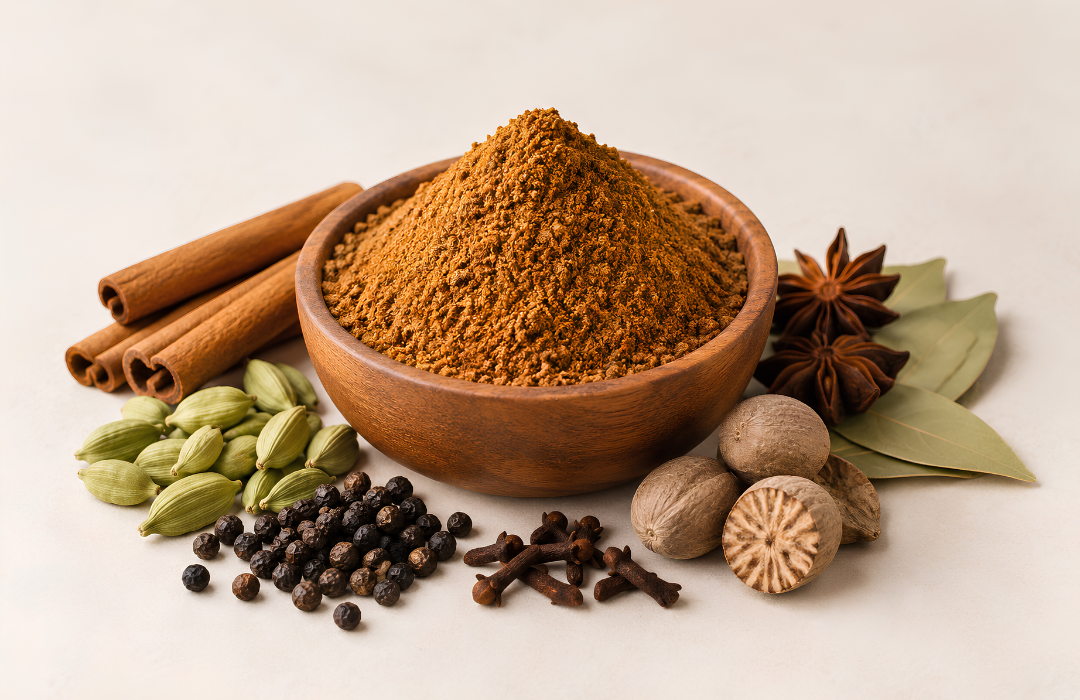
Grind your spices, and keep the batch small. Here is the beginning mixture for cooking most North Indian dishes:
- 2 tbsp coriander seeds
- 1 tbsp cumin seeds
- 1 tsp black pepper corns
- 8 green cardamom pods (use the seeds only)
- One 2″ piece of cinnamon bark
- 6 cloves
- One bay leaf
Roast the spices over a low flame for two to three minutes, continuously stirring, until the aroma starts coming out. Sprinkle the spices onto a plate and allow them to cool down, as warm spices tend to lump up and clog the
mixing jar. Pulse grind the spices and store the powder in an airtight steel jar not close to the stove; consume the powder within two to three months and prepare another batch.
The spice grinder does all the work, and the batch will cost you less than the fancy jar. The true reward is the wonderful aroma when opening the lid after cooking.
Still keep the purchased jar for the long stewing period. The stew or mutton curry cooked for one hour anyway destroys the delicate top notes in any case, so using the fresh spices will waste their best qualities here. The finishing sprinkle has no place to hide. Fresh spices belong to the dish’s surface, and the spice jar should go to the pot.
It is because of the right time and freshness that garam masala gets its rightful place in Indian cuisine. Consider the final minute of your cooking process as another ingredient, and you would notice a difference in every pot of dal, rajma, or chicken curry cooked.